Dot: What It Is and Why It Matters in Crypto

Last Updated: July 27, 2026
Dot (DOT) is the native cryptocurrency of Polkadot, a multi-chain blockchain protocol designed for interoperability and scalability. Unlike traditional blockchains that operate in isolation, Polkadot connects multiple specialized blockchains—called parachains—through a central relay chain. DOT powers this ecosystem by enabling governance, staking, and bonding functions. Holders can vote on network upgrades, nominate validators to secure the chain, and lock tokens to support new parachains. Understanding how dot works matters whether you're evaluating Layer 1 alternatives, comparing proof-of-stake models, or exploring cross-chain DeFi opportunities. Polkadot's architecture allows projects to share security while maintaining sovereignty, reducing the cost and complexity of launching a blockchain. If you're interested in how networks achieve scalability without sacrificing decentralization, learn more about blockchain fundamentals and explore staking strategies to see where DOT fits. By the end of this piece, you'll know what DOT does, how its tokenomics shape the network, and whether it aligns with your portfolio or development goals.
Dot at a Glance: Key Metrics
| Metric | Value | Function | Implications |
|---|---|---|---|
| Token Symbol | DOT (formerly split 1:100 in 2020 redenomination) | Used across all Polkadot applications and governance tools | Ensures consistent pricing and reduces confusion after the denomination change |
| Consensus Model | Nominated Proof-of-Stake (NPoS) with validator elections every era | Secures the relay chain and all connected parachains simultaneously | Higher capital efficiency than single-chain PoS; lower barrier for projects launching parachains |
| Annual Inflation | ~10% target, adjusts based on staking ratio (ideal 50% staked) | Rewards validators and nominators; incentivizes active participation | Inflation dilutes non-stakers but aligns with security budget; no hard cap on supply |
How Dot Powers the Polkadot Ecosystem
Polkadot's relay chain doesn't run smart contracts or process user transactions directly. Instead, it coordinates parachains—independent blockchains with their own logic, tokens, and governance—while providing shared security. DOT serves as the economic glue. Stakers lock DOT to nominate validators, who produce relay-chain blocks and validate parachain state transitions. This shared security model means a new parachain doesn't need to bootstrap its own validator set from scratch; it inherits protection from the entire network. Governance happens on-chain: DOT holders propose and vote on runtime upgrades, treasury spending, and parachain slot auctions. The bonding mechanism lets projects lock DOT to secure a parachain slot for a fixed lease period, creating predictable deployment costs. Because the relay chain handles consensus and finality, parachains can focus on specialized use cases—DeFi, identity, IoT—without replicating security infrastructure. For a deeper dive into how interoperability protocols compare, see the W3C Web3 standards documentation and read our guide to cross-chain bridges.

Six Reasons Dot Stands Out Among Layer 1 Tokens
Evaluating DOT means looking beyond price charts to its structural role in the network.
- Shared security architecture DOT stakers secure dozens of parachains at once, spreading validator costs across the ecosystem rather than duplicating them per chain.
- On-chain governance with no hard forks Protocol upgrades execute automatically when approved by token-weighted voting, avoiding contentious splits and governance theater.
- Parachain slot auctions Projects compete for slots by bonding DOT in a trustless auction; winners get guaranteed block space, losers get their tokens back after the lease expires.
- Cross-chain message passing (XCMP) Parachains send assets and data to each other natively, without third-party bridges or wrapped tokens—a feature baked into the protocol.
- Flexible staking with nomination pools You don't need to run a node; nominate up to 16 validators with as little as 1 DOT, earning proportional rewards minus a small pool commission.
- Treasury-funded development A portion of transaction fees, slashing penalties, and inefficiency penalties flows into an on-chain treasury, funding grants and public-good infrastructure voted on by DOT holders.
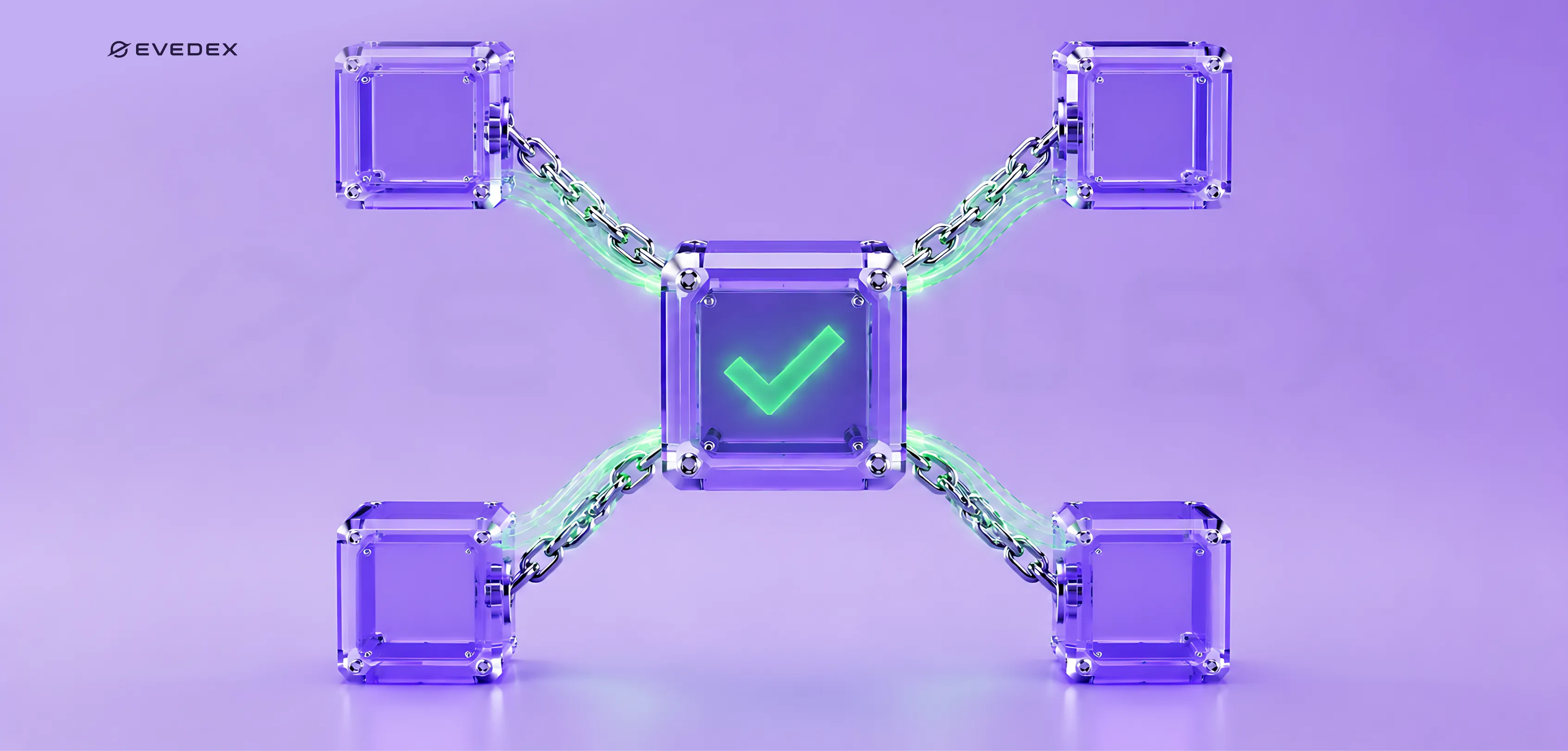
The combination of scalability through parallel processing and interoperability through native messaging gives DOT a different value proposition than single-chain competitors. If you're comparing ecosystems, check out our Ethereum vs. Polkadot breakdown to see trade-offs in design and adoption. The image above illustrates how relay chain validators coordinate finality across parachains—each colored chain represents an independent state machine secured by the same validator set. According to Polkadot's official documentation, this architecture can theoretically support over 100 parachains, though real-world throughput depends on parachain optimization and relay-chain capacity.
Trading and Using Dot on EVEDEX
EVEDEX lists DOT as a DOT-USD perpetual contract with USDT margin, so you can open a long or short position on its price without owning the coin. The platform offers no spot trading, no staking, and no cross-chain swaps, so DOT set aside for validator nomination stays in your own Polkadot.js wallet. You fund your account in USDT from another exchange or your wallet, and the deposit window can convert coins from other networks into USDT. The platform supports market, limit, stop-limit, and take-profit/stop-loss orders plus advanced charting, so you can swing trade governance events or hedge a long-term holding with a short position, with fees no higher than 0.015% maker and 0.045% taker before cashback.